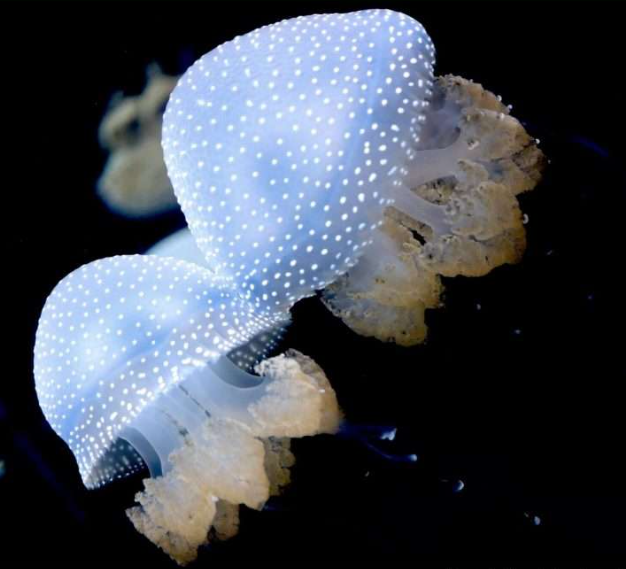
Our third common jellyfish is one originally native to the western Pacific that has now spread around warm and temperate waters to become common as an invasive species.
The white-spotted jellyfish, also called the floating bell and Australian spotted jellyfish, filter feeds on zooplankton while it swims and can reach a pretty significant 50 centimeters / 20 inches in diameter.
In keeping with the rest of our common jellyfish, the venom from the white-spot is mild and isn′t considered harmful to people.
These jellyfish drift in significant numbers eating large quantities of zooplankton. Indeed, they′re so efficient that they can filter food from up to 50,000 liters (13,000 US gal) of seawater per day.
In areas such as the Hawaiian Islands, Gulf of California, Gulf of Mexico, and the Mediterranean Sea, where they are an invasive species, they can consume so much plankton that native species cannot get enough food. This can affect the populations of local fish, shrimp, crab, and other animals.
It is believed that the jellyfish have traveled around the world in ships′ ballast tanks. Juvenile animals are sucked into the tanks and later dumped into new waters. The jellyfish can thrive where their regular predators, marine snails, are absent.